

To THERAPY OR TO NOT?
- MyPolar
- Oct 23, 2018
- 3 min read

“Self love is asking yourself what you need – everyday – and then making sure you receive it.”
Weather: sunny, mild
Mood: inquisitive, thoughtful, engaged
My Therapeutic Evolution
Currently, the only professional support I have re: my bipolar condition involves my psychiatrist. I greatly admire and respect her; she’s a solid confidante, source of accountability, and someone who’s intimately known my trials and tribulations for over 3 years. As I was beginning to receive treatment, I did try seeing a therapist; at no fault of his own, those sessions struggled to maintain my attention, investment, or buy-in to its overall help and personal application.
Until this year, where I was forced to receive substance abuse counseling for my placement on probation, I’ve always just been content with owning my recovery via medications, and the tools I’ve accumulated among my personal wellness recovery toolbox. Being frustrated with my substance abuse struggles (and the lack of tangible support/advice/guidance) the program wasn’t offering, it forced me to do research and find solutions for myself. In the process, I felt I had an orientation to what therapy is definitely, what types exist, and what options I actually have in finding additional recovery support. For me, cognitive-behavioral (CBT) and positive psychology are two asset-based, self-introspective, & optimistic approaches that I highly enjoy and derive plenty of benefits from. Never knowing so much existed out there, nor being shown such, I wanted to give a quick rundown of one professional’s approach to succinctly portray the “therapy landscape” to hopefully help our community be empowered to make personal, informed decisions to what support can look like for them.
The CAST Theory Model

The Character Adaptation Systems Theory (CAST) is a model “linking integrative psychotherapy to the science of human psychology via…systems of character adaptation.” The five systems of character adaptation include:
1. The Habit system
2. The Experiential system
3. The Relationship system
4. The Defensive system
5. The Justification system


One major systemic barrier the CAST approach aims to address (that I completely agree with) is the segmented-disjointed nature of psychotherapy and psychology; on Wikipedia there are over 150 different types of approach professionals can use to offer treatment to those suffering from mental health conditions. Yep, that’s a lot.
Beyond categorizing therapies based on character adaptation systems, the CAST model also classifies approaches by the 4 classic traditions individual psychotherapy programs have been developed among:
1. Psychodynamic
2. Behavioral
3. Humanistic
4. Cognitive
I know this is dense and lots of jargon/industry-speak, but I’ll be following up on this model & theory by breaking down the traditions in upcoming posts. Until then, maybe my created interpretation of his model may be a different, more accessible representation of his proposal. Hopefully, these visuals and coherent organization are exciting and optimistic for feeling more informed, aware, and empowered to own your recovery model.
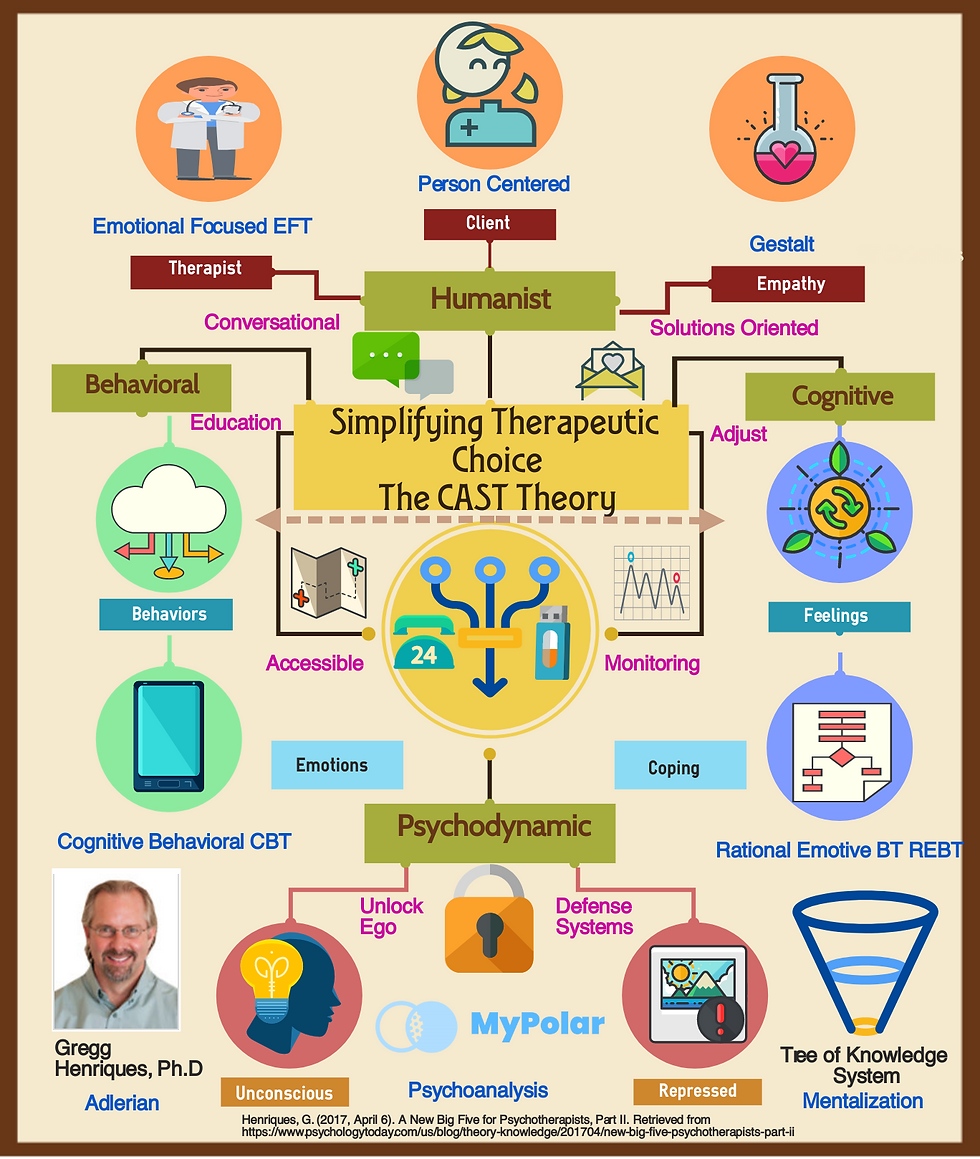
The economy of mental health support (professionally) is systematic, disjointed, and has many channels. Even if you’re receiving professional support, you may not know all that exists because there’s simply so much out there. Research and knowledge can help inform your best decision-making.
Before you go!
o Comment Below: are you involved in therapy? What kind of therapy?
o Check this out!: The CAST Theory article & author-written commentary on his process of development & our infographics page to see 10 psych- words you may not know the definition of.
One last thing: if you could subscribe, MyPolar would be so appreciative. We promise to not spam, nor become a nuisance. Hoping to spark a movement championing bipolar, having allies, partners, and a larger community is imperative.


Comments